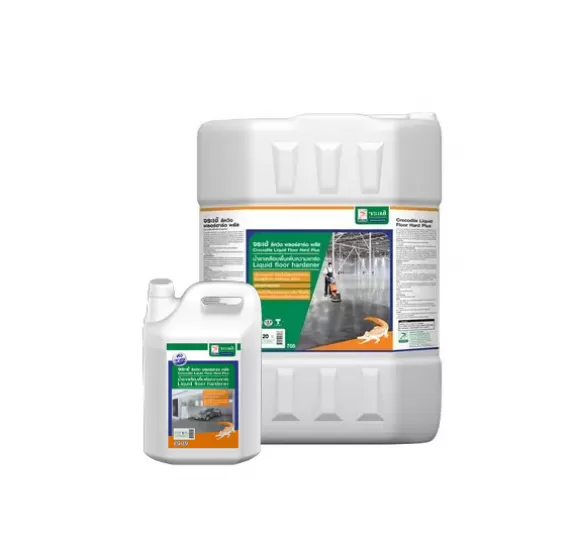
Crocodile Liquid Floor Hard Plus

A solution for polished concrete to increase surface hardness and polish and seal the concrete surface to reduce water penetration

  • For polishing and sealing concrete surfaces to reduce water penetration.
  • For polished concrete applications to increase surface hardness and gloss.
  • Reduces water penetration and prevents dirt stains from penetrating into the surface.
  • Applicable for both exterior and interior use.
  • Suitable for both new concrete surfaces and old concrete or with proper surface preparation only.

Packing: 20 liters/bucket, 5 liters/gallon

Crocodile Liquid Floor Hard Plus is a water-based hybrid silicate solution, used for polishing and sealing concrete surfaces to reduce water penetration, and for polished concrete applications to increase surface hardness and gloss without the need for additional coating materials. It features water penetration reduction properties, is ready to use, and can be applied on both new concrete surfaces and old concrete surfaces with sufficient strength or proper surface preparation only. Suitable for both exterior and interior applications, it is designed for all types of cement floors, such as industrial floors, warehouse floor, parking floor, office buildings floor, and etc.

How To Use

Application Instructions

The product works by penetrating the surface to initiate its reaction. Therefore, whether for new or old concrete, to achieve optimal product performance, it is necessary to ensure that the surface has sufficient strength, that the product can penetrate the surface, and that proper surface preparation is carried out. The details of surface preparation should take the following aspects into consideration.

Substrate Preparation for *New Concrete

  • The surface water absorption should be tested to determine if it can absorb water, using the water drop test. If the water does not penetrate the surface, or in the case of polished concrete, surface preparation must include grinding the concrete surface with a floor grinder using a floor stripping pads to open the surface before application. This removes the dense top layer, allowing the product to penetrate the surface.
  • The surface must be dry with a moisture content not exceeding 14%, as measured with a moisture meter.
  • The surface must be clean, free of dirt, dust, oil, and other contaminants. In case of fungi or algae on the surface, it is recommended to clean with a specially designed cleaning product.

Note : *New concrete refers to concrete that has been poured for no more than 28 days.

Substrate Preparation for Old Concrete

  • The surface strength must be checked before each application
  • The compressive strength of the surface before application should be measured using a Schmidt Hammer. The minimum acceptable strength is 200 KSC.
  • Surface cracks should be inspected and properly repaired before application.
  • The surface water absorption should be tested to determine if it can absorb water, using the water drop test. If the water does not penetrate the surface, or in the case of polished concrete, surface preparation must include grinding the concrete surface with a floor grinder using a floor stripping pads to open the surface before application. This removes the dense top layer, allowing the product to penetrate the surface.
  • In case of surfaces previously treated with polished concrete or floor hardener, it is necessary to grind the concrete surface with a floor grinder using a diamond grinding block wheel to open the surface before application. This removes the dense top layer of the previous surface, allowing the product to penetrate into the concrete.
  • Check for surface delamination by tapping the surface with a hammer. A hollow sound indicates voids or delamination beneath the surface. In such cases, the concrete surface must be ground with a floor grinder using a floor stripping pads until reaching the sound concrete layer before application.
  • Check for contaminants or stains on the existing surface before application. If any contaminants or stains are found, they must be properly cleaned using an appropriate method.
  • The surface must be dry with a moisture content not exceeding 14%, as measured with a moisture meter.
  • The surface must be clean, free of dirt, dust, oil, and other contaminants. In case of fungi or algae on the surface, it is recommended to clean with a specially designed cleaning product.

Application

For polished concrete floors to increase surface hardness and gloss

  1. Check and prepare the concrete surface strictly following the surface preparation instructions.
  2. When the surface is confirmed to be strong and suitable, grind the surface with diamond pads, starting with grit #60 over the entire floor, then continue grinding with grinding with grit #150, #300, and #500 respectively.
  3. Apply the product 2–3 coats, depending on the porosity of the surface, by spraying or rolling. Each coat must be applied so the product fully penetrates the concrete. Use a cloth, sponge, or rubber squeegee to wipe off excess product before it sets to avoid puddling that can cause white stains or may cause delamination of the solution and result in a weakened surface. Each coat should be applied continuously without waiting for the previous coat to dry completely (wet on wet), depending on the working temperature.
  4. Then polish the surface with diamond pads grit #1000, #1500, and #3000 respectively to obtain a smooth and glossy finish. For polished concrete work, higher grit polishing can be done beyond the numbers specified depending on the required level of gloss.
  5. The area can be opened for light foot traffic after 24 hours, and for heavy traffic after 7 days.

Note: The final surface of polished concrete depends on the skill and workmanship of the applicator.

For polish and seal the concrete surface to reduce water penetration

  1. Check and prepare the concrete surface strictly according to the surface preparation instructions before starting work.
  2. Apply the product in 2–3 coats, depending on the porosity of the surface, by spraying or rolling. Each coat must be applied to ensure the product fully penetrates the concrete surface. Use a cloth, sponge, or rubber squeegee to remove any excess product before it sets to avoid puddling that can cause white stains or may cause delamination of the solution and result in a weakened surface. Each coat should be applied continuously, without waiting for the previous coat to dry completely (wet-on-wet), depending on the working temperature.
  3. To enhance deep penetration of the product, polish the surface with floor polishing pads after applying each coat.
  4. Each coat must fully penetrate the concrete surface. Any product that pools on the surface must be completely removed using a rubber squeegee or by wiping with a clean cloth or sponge to prevent puddling.
  5. The area can be opened for light foot traffic after 24 hours, and for heavy traffic after 7 days.

Estimated Coverage
3-5 sq.m / liter. It depends on the type and condition of the substrate. The exact consumption must be determined by means of a sampling of the work.

Equipment

  • Chemical sprayer
  • Roller
  • Concrete floor grinding machine
  • Floor polishing pads or diamond pads
  • Clean cloth, sponge, or rubber squeegee

Recommendations

  • For new concrete surfaces, allow the concrete to cure for at least 14 days for polish and seal the concrete surface and at least 28 days for polished concrete.
  • In case of rain, wait until the surface is completely dry before applying the product.
  • For optimal performance, strictly follow the recommended surface preparation and application procedures.
  • For increase performance of solution penetration, in the case of for polish and seal the concrete surface to reduce water penetration. It is recommended to scrub with a floor polishing pad after each coat of the solution.
  • For maximum hardness, concrete should be treated using the polished concrete procedure to increase both strength and gloss.

Cautions

  • Do not allow the product to pool on the concrete surface, as this can cause white stains or may cause delamination of the solution and result in a weakened surface. This can be prevented by proper application and by using a cloth, sponge, or rubber squeegee to remove any excess product before it sets.
  • Do not apply the product to wet or damp surfaces, as this will prevent proper penetration into the concrete.
  • Each coat should be applied continuously without waiting for the previous coat to dry; otherwise, the product may not penetrate the surface properly.
  • Use PPE during applications, such as gloves, dust masks, and safety glasses.
  • Work in well-ventilated areas.
  • If the product gets into the eyes, rinse immediately with plenty of clean water and seek medical attention promptly.
  • Keep out of reach of children.
File Download Requirements: For optimal system performance and stability, the total file size for each download session is limited to 50 MB.
If the selected files exceed this limit, the system will be unable to proceed with the download.
0.19 MB

Please fill in all required fields (*)